

What Small Businesses Need to Know About Digital Marketing Services Before Spending More Money
Most small-business owners aren't unreasonable when they abandon digital marketing. They lose faith in it because it has failed them.
They tested Google Ads. They've hired someone to "do seo" They've been posting on social media for a few months. Their website has been redone. They've boosted a few posts, waited for enquiries and eventually wondered if digital marketing really works or if it's just another service agencies know how to sell.
The honest, simple answer is: Internet marketing does work.
But it seldom succeeds if it's approached as a string of unconnected tasks. A few Instagram posts are hardly a strategy. A website does not create leads by itself. Sales are not traffic. Paid ads do not solve weak positioning. SEO doesn't work miracles in three weeks. The actual problem is not digital marketing. The problems are bad sequencing, fuzzy expectations, insufficient measurement and disjointed implementation. Small businesses don't need more noise. They require a viable, quantifiable and commercially aligned digital growth system.
Market Has Changed
Ten years ago, local businesses had a natural advantage: proximity. A bakery in Lucknow, a clinic in Kanpur, an accountant in Jaipur or a coaching college in Delhi could be highly dependent on location, references and neighbourhood knowledge. If the people close by trusted the business, that trust formed a shield.
That barrier has now become a lot less scary.
Find it out today on the web.
When a customer looks for "best bakery near me", "affordable dentist in Kanpur", or "digital marketing agency for small business", they get to see many possibilities right away. The same screen you have local competition, franchise companies, aggregators, Instagram-first brands and newcomers. The customer doesn't care who's been around longer. They worry about who comes up as most relevant, credible, visible and accessible when they are ready to act.
This is the point where modern business is won or lost.
Businesses that got this early have been establishing search visibility, reviews, content, paid advertising, landing sites and follow-up systems for years. A lot of them aren't ahead because they had bigger budgets. "They have a lead because they started earlier and they have been consistent."
When digital adoption is delayed, it is not neutral. It's against you.
The Truth About Digital Marketing Services "Digital marketing services" is a broad term, but for a small business, it usually boils down to one thing: creating a solid digital route from visibility to inquiry to sale.
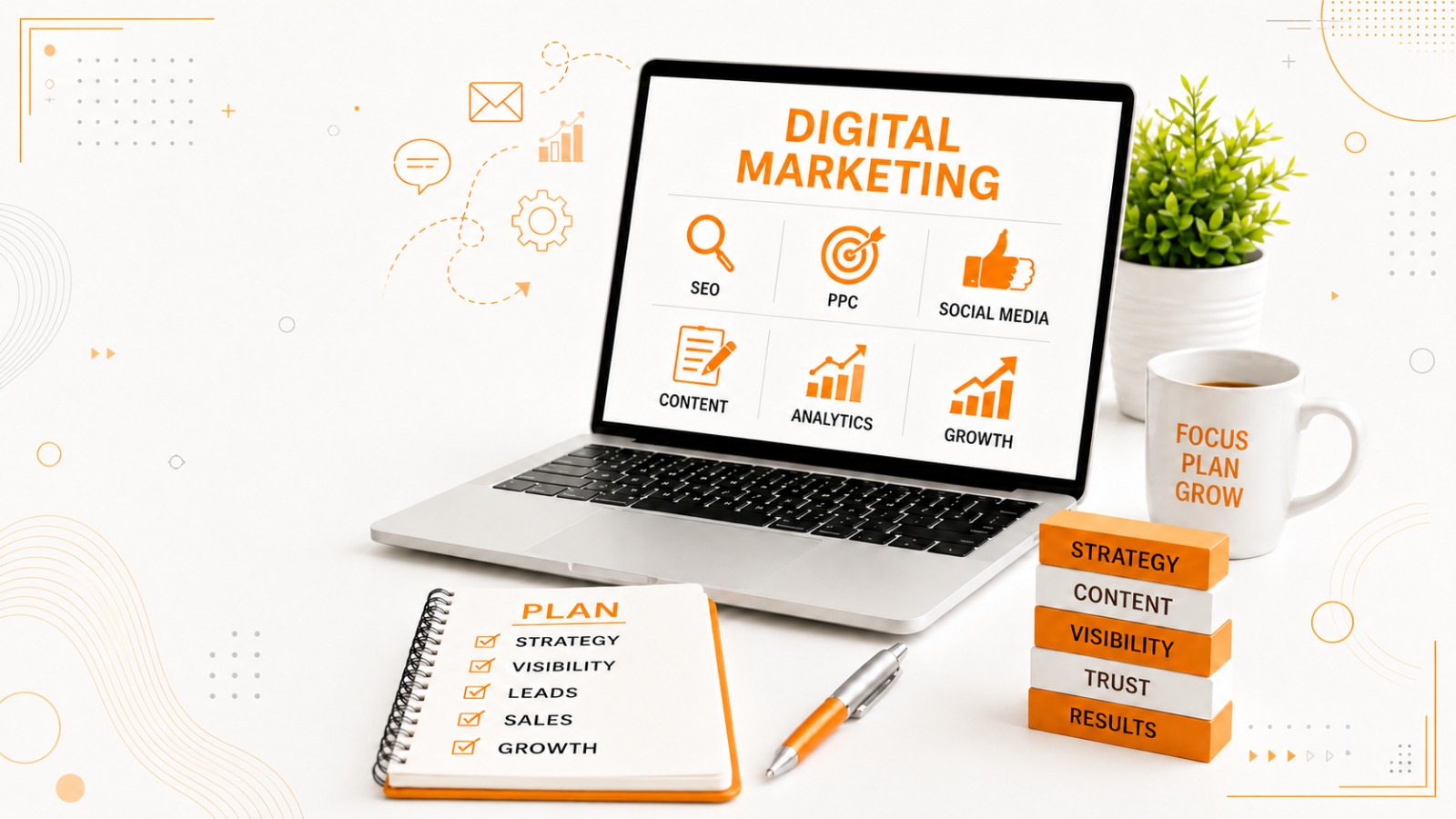
This could include SEO, paid ads, content marketing, social media, email automation, landing pages, local SEO, conversion optimisation, analytics and retargeting.
- There is a purpose for every ingredient.
- SEO organically helps buyers find you.
- Paid ads get you in front of people faster.
- Content establishes trust before the sales interaction starts.
- Social media creates memory and recognition.
- Email keeps warm leads warm.
- Landing pages convert interest into action.
- Analytics indicates what works and what is squandering money.
The mistake is to consider these services as separate jobs, instead of linked components of a single business engine. The most effective digital marketing occurs when the customer journey is well defined. Get the proper people. Build trust. Make it easy to take the next step. Measure the result.
Without such structure, even good strategies fail.
SEO: Slow yet long-lasting.
Search engine optimisation is often misunderstood since it doesn't work in the same way as advertising.
Advertising buys attention. With SEO, you create authority. When someone types in "kids birthday cake Lucknow", "best physiotherapy clinic near me" or "affordable accountant in Jaipur", the purpose is already there. They are not passive consumers. They are seeking a solution.
- If your business shows up at that point, you are part of the decision-making process.
- If it does not, the decision is taken out of your hands.
SEO for Small Businesses Depends on 4 Essentials.
The first is to understand the search intent.
Business owners often use professional terminology to explain services. Customers search in plain language. A company can advertise itself as a "residential cleaning solutions provider". A consumer types "home deep cleaning near me." That's where SEO comes in.
The second is on page optimisation.
Your website should be easy to read, speedy, organised, mobile-friendly and easy for search engines to crawl. Page titles, headings, internal links, service pages, metadata and relevant content all matter.
The third is local SEO.
If your firm is a local one, then you have a big advantage with your Google firm Profile. Map visibility is impacted by reviews, photographs, categories, service areas, local citations, and accurate business info. For many local businesses, Google Maps drives more leads than their own website.
Fourth: Content. Blogs, FAQs, tutorials, service pages and comparative pieces.
It assists clients in understanding their alternatives and boosts your search presence. Good material isn't there to fill space. It addresses actual questions. It lowers buyer reluctance.SEO is a process. Usually takes some time for results to be meaningful. But worth can grow as power starts to accrue. Paid adverts end when the budget ends. Strong organic visibility can continue to work long after that first effort. This is why SEO remains one of the most essential long-term assets that a small firm can establish.
PPC: rapidity under control
Not every firm can wait months for SEO results. Sometimes you need the enquiries now. The business could be launching a new service, in high season, facing more competition or trying to evaluate demand fast. Here's where pay-per-click advertising comes into play.
Google Ads may get your business to the top of search results in days. Meta ads can build awareness and retarget interested parties. LinkedIn Ads reach professional decision-makers, and YouTube and display advertisements, which can help with awareness and recall. But sponsored advertising is a bad term. Poorly designed campaigns are costly.
The usual faults are predictable: broad targeting, weak keywords, poor ad text, no negative keyword strategy, irrelevant landing sites, no conversion tracking, and no idea of cost per lead.
And so the line "Google Ads didn't work for us" gets said a lot by business owners. The platform was often not the problem. The architecture of the campaign was.
Good PPC isn't about purchasing clicks.
It's about buying relevant attention at a price the business can pay. This takes discipline: precise targeting, intent-led keywords, excellent landing pages, conversion tracking, constant improvement, and a serious awareness of margins.
PPC can be worthwhile - but only if run with a commercial rationale. Otherwise, it's expensive guesswork.
Content marketing: trust before conversion
Most of your customers will not buy the first time they see you. They do research. See if you can tell the difference. Ask questions. Read Reviews Look for evidence. See whether they know their problem. All of this is driven by content. A good article, service guide, case study, FAQ, comparison website or instructive video can solve client doubts before they even talk to you. There's no pressure, only confidence-building.
That's the true power of content marketing. It's not only about getting found on Google. It's about exhibiting expertise. The gap between a business that declares "We're the best" and a business that explains the customer's problem better than anybody else is massive.
The second is trust building.
Small businesses have a real advantage here. Big brands tend to sound contrived, yet lifeless. Their content goes through stages of vetting until the human understanding is lost. The small business owner knows what his customers really object to. They know the blunders that buyers make. They know what competitors won't say. They have the questions people ask before they make a decision. That hands-on experience is good stuff.
The best content doesn't sound like it's trying to be clever. It sounds knowledgeable, specific, and helpful. That's what makes folks think it.
Social media: exposure is not a tactic
A lot of small companies confuse blogging with marketing. Posting is a thing. "Marketing is a machine. A page with festival creatives, generic quotations, random reels and the occasional offer could look busy, but activity doesn't build demand. Social media should communicate three things to people: Who you help, what you help them with and why they should trust you.
Social networking is most effective for small businesses to generate awareness and reputation. This includes instructive postings, founder insights, customer anecdotes, testimonials, behind-the-scenes, service explainers, and offers with clear calls to action.
It's about more than interaction. The aim is commercial familiarity."People are more likely to enquire when they remember you, understand you, and trust you.
Social media, in a planned way, assists the sales process. Used at random becomes ornamentation.
Email marketing: the neglected revenue channel
Email marketing might not be the most trendy channel, but it is one of the most beneficial for small businesses. The explanation is obvious. An email list isn't cold traffic.
These are the people who have already done business with you. They may have asked for information, bought something, downloaded something, booked a consultation or expressed interest in a service.
That makes them warmer than a brand-new audience. Email's real strength is in automation. Welcome sequence to a new enquiry. Existing customers may be offered a reactivation. Useful follow-up information can be given to first-time buyers.
Reminders, case studies or educational content can be sent to a lead that did not convert. It is not a manual chase. It is a follow-up with the organisation. Most small businesses spend money generating leads and then don't follow up on them. They collect names, numbers and email addresses, but do nothing useful with them.
That is revenue lost. If a lead is expensive to get, it needs a proper follow-up procedure.
Landing pages: the success or failure of campaigns
You can have the correct audience, the perfect keywords and a great ad in a campaign. But it can still fail if your landing page sucks. This is one of the most prevalent reasons why small firms spend their advertising cash. A lot of firms send bought traffic to a generic webpage. But when someone clicks on an ad, they have a certain aim. They looked for one service, one product, one solution. They don't need a wide introduction to the whole business. They have to be relevant."
A strong landing page would match the search purpose, clearly communicate the offer, quickly create confidence, deal with concerns, provide proof, and make the next step obvious. This requires a bold headline, clear benefits, testimonials, service details, FAQs, visible contact options and an easy enquiry trail. Traffic does not inevitably become money. And that's what conversion design does.
Analytics: growth requires proof
In digital marketing, to be optimistic without analytics is expensive: traffic, reach, clicks, form submissions, calls, WhatsApp messages, etc. But if they are not tracked accurately, no one knows what really works. That makes terrible choices.
A firm might keep paying for campaigns that generate low-quality leads. It may close down quietly successful routes. It could assess marketing on emotion rather than fact. Good analytics provides clarity.
It shows you where traffic comes from, which sites convert, which campaigns create enquiries, where people drop off, and how much each lead costs. This shifts the discussion. Marketing is no longer a vague expense; it is something that can be improved. You are not scaling at all without measurement. You're just guessing.
What tiny business should focus on first?
A small firm doesn't need all digital marketing services at once. It needs the proper order.
First, fix discoverability. Ensure clients can find you on Google Search, Google Maps, social sites and local listings.
Second, credibility fixed. Enhance your website, reviews, service pages, images, testimonials and messaging.
Third, fixed conversion. Make it easy for your people to inquire via WhatsApp, forms, calls, landing pages, and clear offers.
Fourth, measurement fixation. Track enquiries, calls, traffic sources, campaign performance and lead quality.
Fifth, Acquisition of scale. Use SEO, PPC, content, email, remarketing and social media based on data, not assumptions. This order is important. Running advertising without improving your landing page is a dead end.
Posting regularly without positioning is just noise. Publishing blogs without a keyword strategy is a waste of time. Collecting leads and not following up is sloppy. It's not a scattershot effort; it's about sequencing and growth.
The cost of delay
A lot of small businesses wait to start digital marketing until they have clarity. That certainty never comes.
Markets evolve. Platforms evolve. Competing goes. Search results change. Advertising costs increase. Changes in consumer behaviour. Waiting doesn't decrease risk. It usually raises it.SEO is a marathon. Takes time for content. It takes time to review. Building email lists can take time. Brand recall is a process.
Any business that starts creating these assets now will be stronger six months from now. A business that waits six months will still have to start later, in a more competitive climate. It's okay to start small. It's okay to start imperfectly. No measurement: no start."The objective is not to go crazy from day one. The goal is to develop and measure a digital foundation that can be scaled.
Final comment.
Digital marketing is not an all-in-one solution. This is not a shortcut, and it is not a guarantee that every business will grow just because it has a website, runs ads or posts on Instagram. This is a commercial system.
When done right,t it makes you more visible, more trustworthy, creates more enquiries, makes it easier to acquire customers and promotes demonstrable growth. If not well constructed, it is an expensive series of disconnected activities. The fundamental question is not if digital marketing works.
The true question is, is your business constructing it with the clarity, discipline and consistency to make it work?
While you are still contemplating whether to get started, your competitors are gathering reviews, earning rankings, growing audiences, testing advertising, enhancing data and establishing customer trust. It does not fill that gap. It broadens.
If you're ready to stop guessing and start constructing a digital growth strategy you can measure, let's have a real chat about what your business actually needs.
F.A.Q. (Frequently Asked Questions)
What is a good digital marketing budget for a small business?
There is no one universal figure. A better question might be: What is a budget the firm can live with consistently for at least six months? Regular, targeted spending often outperforms sporadic bouts of high spending.
Does SEO still matter with AI searches?
Yes, but poor SEO is getting less effective. At the core of AI-led search is still reliable, structured and usable material. Enterprises that have strong thematic authority, local relevance, reviews and helpful content fare better than enterprises with thin websites and poor visibility.
What's the biggest mistake small businesses make with Google Ads?
Paid traffic to a non-specific home page. A search ad should take the user to a page that is an exact match for the user's purpose. Poor landing page relevancy is one of the quickest ways to blow ad investment.
How long does SEO take to work?
Most small businesses can expect to wait three to six months before they see meaningful SEO traction. Sometimes local SEO can be quicker, but competitive markets tend to be longer.SEO is slow initially as it takes time to gain authority. As the momentum builds, the returns can compound.
Is digital marketing too much for a small corporation to do internally?
Yes, but not so bad as . . . Basic writing, social media, website upgrades, and client interactions can all be done in-house. Technical SEO, paid campaign management, analytics, conversion tracking, and strategy typically demand specialist skills. The practical approach is simple: do domestically what you do well and outsource the areas where mistakes are costly.