

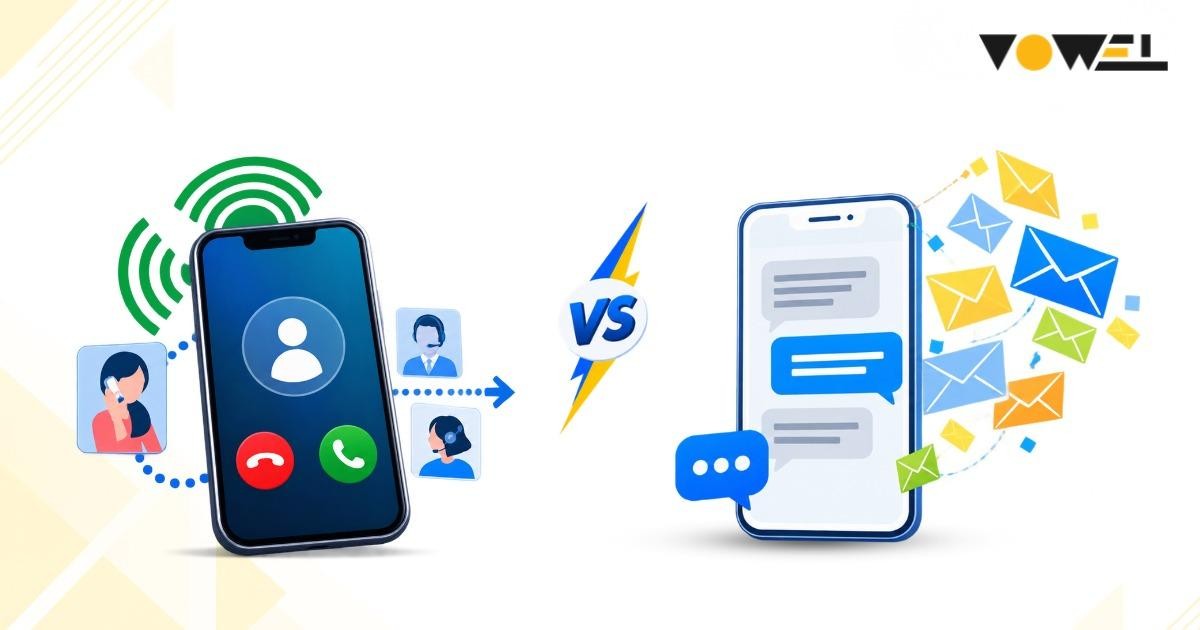
Voice Call vs SMS Marketing: Which Converts Better?
"Bhai, SMS bhejein ya call karwayein?" If you run a business in India you've probably asked this at some point, or heard someone in the office ask it. Answer? Depends. On what you sell, who's buying, and what you need them to do next. Annoying, haan, we know. So let's actually break it down.
Both voice calls and SMS are old school compared to WhatsApp and Instagram. But in India they still reach people that apps don't, like the uncle with a keypad phone, the shopkeeper who never checks WhatsApp during business hours, or the patient in a small town with patchy internet. That's why the voice call vs SMS marketing debate hasn't gone away.
Quick Basics Before We Compare
SMS marketing you already know. That text from VM-SHOPXY or whatever, with the 20% off, the OTP, the 'your order is out for delivery'. Cheap, short, goes out in lakhs.
Voice call marketing is the automated version of a phone call. A recorded voice, or a computer one, and maybe a 'press 1' at the end, which makes it IVR. Bulk again, only now people listen instead of read.
DLT applies to both. TRAI keeps an eye on both. Neither one is a free ride.
Where SMS Wins
Cost is the obvious one. Per message, SMS is usually cheaper than a voice call, and if you're sending to lakhs of numbers that gap adds up.
Then there's the written record. An SMS stays in the inbox. The customer can look at the date, the address, the coupon code, the link, whenever they want. A call is gone the moment they hang up, and if they didn't catch the time properly, tough luck.
SMS is also less intrusive. Nobody enjoys their phone ringing in a meeting or on the bike. A text waits. And imagine getting a call for your OTP or 'parcel delivered' update. Weird, right? That stuff belongs on SMS.
And links. If you want someone to click, pay, fill a form or open a page, SMS can carry the link. A voice call can't, unless you follow it up with a text anyway.
Where Voice Calls Win
Attention, mainly. A text can be swiped away without being read. A ringing phone at least gets picked up and heard for a few seconds, which is more than most promotional SMS get.
Language and literacy matter a lot in India. Plenty of customers, especially older people or those more comfortable in Hindi or a local language, won't read an English SMS properly. A twenty second call in Hindi or Punjabi lands much better with them.
Then the response. With an IVR option the customer can press 1 right there, to confirm, book, or ask for a callback. You get an answer back in the same call, not a "seen" that tells you nothing.
And trust, in some cases. A human sounding voice explaining an offer can feel more real than a text with a link, especially in a time when everybody is scared of SMS scams.
So Which One Converts Better?
No one winner here, sorry. Depends what 'convert' means in your business.
- Need a click, a payment, a form filled? SMS, because the link sits right in it.
- Need a yes or no quickly? Call with IVR. They press 1 and you have your answer before they've even put the phone down.
- Customers older, or in small towns, not big on reading? Voice gets through to them better.
- OTPs, order updates, transactional stuff? SMS. Not even a discussion.
- If the message is urgent and time bound, like an appointment tomorrow morning, a call is harder to ignore.
Cost Comparison, Roughly
We won't throw exact rates here because they change with volume, route and provider. But the general pattern is this. SMS gets billed per message, one standard SMS being up to 160 characters. Calls go per call or per pulse, 15 or 30 seconds normally, which means a long-winded script eats money.
Real question though is cost per result. If a thousand SMS bring you five bookings and a thousand calls bring you fifteen, the calls might be the cheaper option even though each one costs more. Run both on a small list and compare.
Why Not Use Both?
This is what usually works best. A lot of smart campaigns now run them as a combo:
- Call, and if no pickup, the same details go by SMS.
- Offer goes by SMS, and a day before it ends, a quick reminder call.
- Put a missed call number in the SMS. Whoever's keen gives a missed call and lands in your IVR.
- Use SMS for the link and the written details, and voice for the push.
The two channels cover each other's weak spots. The call grabs attention, the text stays behind as proof.
TRAI Rules for Both
Whatever you choose, you have to stay compliant. For SMS, your business, sender ID and message templates need DLT registration, and promotional and transactional messages go on separate routes. We've written about this in detail in our DLT registration guide.
For voice, promotional calls are supposed to come from the 140 number series and are checked against the customer's DND preference, as per TRAI's own press release. Automated and pre recorded calls also have to be declared to the telecom operator in advance, as reported by PTI in September 2026. Ignore this and your numbers or sender IDs can get blocked.
Common Mistakes When Choosing Between Them
- Picking one because a competitor uses it. Your customers aren't theirs.
- Using voice for long information. Nobody will remember an address or a twelve digit code read out on a call.
- Using SMS for older audiences without a Hindi version. If they can't read it comfortably, it's wasted.
- Never testing. Send both to a small list, see what comes back, then decide.
- Forgetting compliance. Both channels get blocked fast if DLT and TRAI rules are skipped.
Final Take
Voice call or SMS is kind of the wrong question, if you ask us. Better to ask what you want the customer to do, and who they are. Usually the answer turns out to be both. SMS carrying the details, a call giving the push.
FAQs
Voice call or SMS, which one's better?
Depends on the job. SMS for cheap reach, links and things people need in writing. Calls for attention, confirmations and folks who'd rather listen than read.
Are voice calls costlier than SMS?
Per message, mostly yes. Per lead, not always. If calls get you more replies, they can work out cheaper in the end.
Do people still read promotional SMS in India?
Some do, mostly from brands they already trust. Plenty get swiped away though, which is why adding a call or WhatsApp helps.
Can the same customer get both?
Yep. Call first, SMS if they miss it, is a pretty common combo.
Do I need DLT registration for voice calls too?
Yes. Business registered on DLT, and promo voice templates approved, same as you do for SMS.
When should these go out?
Promotional stuff, daytime only. Beyond that, test it. Your crowd might reply at 11 am, someone else's at 7 pm.
Rural or older customers, what works?
Calls, mostly. A short message in their own language is just easier than reading a text.
Can I put a link in a voice call?
Not in the call itself. But send it by SMS right after, or let them press a key to get it.